IN SHORT

What you get, what it does, what it costs.

What you get

A working test station — fixture, testboard, computing module, software — plus identification hardware if you need it, the test sequence, the operator interface, the traceability database and its API, a results dashboard, documentation, and operator training.

What it does

For each board: programs the firmware, checks electrical integrity, runs functional tests, prints and links a serial number, and returns a clear Go / No-Go with the full detail behind it — every measurement kept.

How it’s priced

A fixed price per step (specify · testboard · fixture · software · deploy), approved before each step starts, with a support envelope built in for the production ramp-up.

Who owns it

You do — schematics, layouts, manufacturing files, test code, documentation: full IP transfer. We keep only the generic core of the test platform, which comes with your project royalty-free.

What it’s for you

Every board verified the same way, a permanent record for your audits and your end-customers, and your engineers staying on the product instead of building and maintaining a test rig.

A one-page summary you can forward internally — to come (PDF).

Talk to us about your board →

HOW IT WORKS

Four parts, working together.

The mechanical fixture

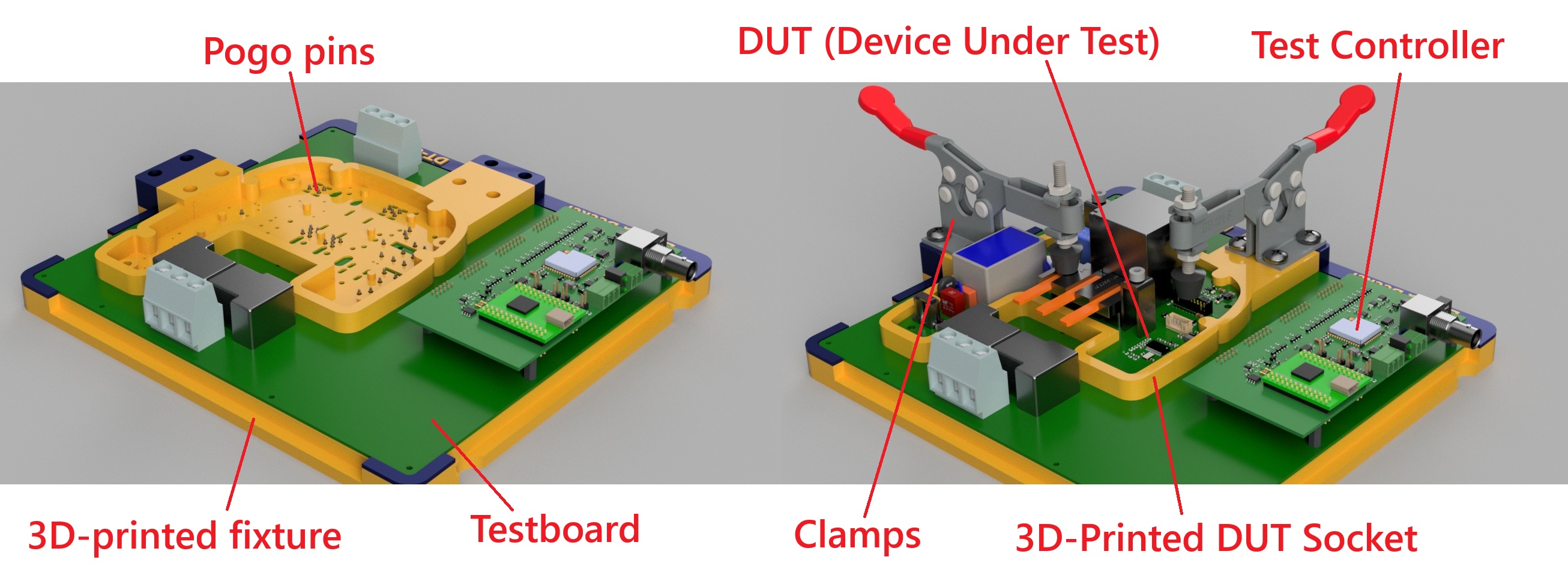
3D-printed parts and quick-action clamps that hold the board under test precisely and repeatably over the testboard — accommodating component heights, connectors and clearances. Being 3D-printed, it comes at a fraction of the cost of a full-blown machined fixture.

The custom testboard

A PCB beneath the board under test, fitted with spring-loaded pogo pins that contact its test points — no soldering, no board modifications. It routes every signal where it needs to go, with signal conditioning and protection where needed — and it carries the interface to a standard computing module.

The computing module

A standard compute module that plugs into the testboard. It runs the test software and the real-time, low-level signal control — driving the buses the test needs (SPI, I²C, UART, RS485, CAN…), GPIO, ADC channels, and any programmable supplies or loads — plus the firmware programmer (SWD, serial bootloader, JTAG, etc.).

The test software

Our web-based platform, running on that module: it executes the test sequence, talks to the instruments and the testboard, evaluates pass/fail, drives the operator interface, and writes the report.

A production testbench: the board under test, held by quick-action clamps over a 3D-printed socket and the testboard; spring-loaded pogo pins contact its test points; a test controller drives the test.
A testbench, end to end — the board under test held over the testboard, pogo pins on its test points, driven by the computing module.
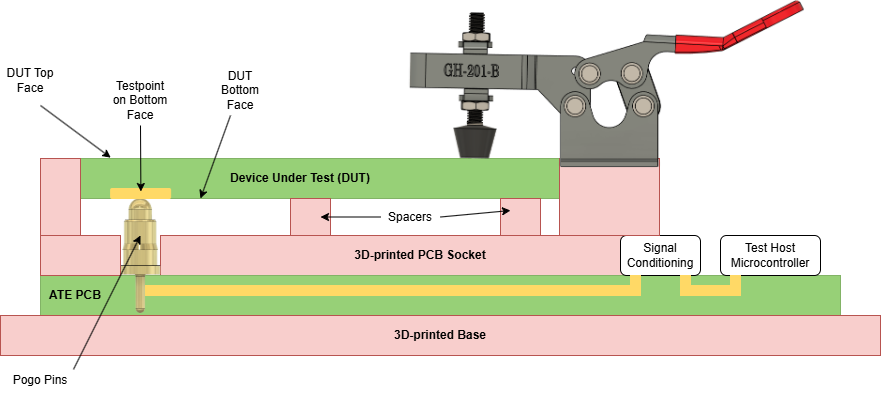
Cross-section of a testbench: a 3D-printed base; the ATE PCB carrying signal conditioning and the test host; spring-loaded pogo pins; a 3D-printed PCB socket with spacers; the device under test on top; and a clamp holding it down.
The stack-up — base, testboard, pogo pins, 3D-printed socket, the board under test, clamp.

More on the test platform →

WHAT IT DOES ON EACH BOARD

Program, check, verify, identify — then a verdict.

Firmware programming

The production firmware is flashed (SWD, serial bootloader, JTAG — whatever the board uses), the flash is verified, and the unit’s serial number is written into it.

Electrical integrity

Supply-rail voltages, ground continuity, short-circuit checks, the voltages on outputs to connectors and peripherals, current draw via shunt — measured against limits, not eyeballed.

Functional tests

High-level features that exercise the hardware end to end — the most efficient way to cover parts that are awkward to probe directly. Where it helps, the board’s CPU is held in reset and the test controller drives each peripheral directly over its bus; resistive loads stand in for motors and actuators.

Identification & traceability

A serial-number label is printed (e.g. Zebra) and scanned; a second QR links the unit to the production order or ERP; the serial is programmed into the device — so the physical label, the firmware identity and the test record all match.

Go / No-Go

The operator gets a clear pass/fail for the board, with drill-down into every criterion — and all the raw measurements are stored, not just the verdict.

THE OPERATOR, IN THE LOOP

A web app for the run — and the manual steps kept where they make sense.

The whole operator interface is a web app — the live test run with all its prompts, the Go / No-Go, the report browser. The operator uses it on a screen at the bench, or from any browser, on-site or over the internet; several screens can follow the same run in sync.

And the test sequence is built around the operator where that makes sense. Some steps are deliberately manual — scanning a serial-number QR, confirming an LED actually lit, pressing a button to check it. A couple of those could be automated, but doing so adds to the testboard and fixture cost for little real gain. We tune the balance between what the bench costs to build and what each test cycle costs to run — and we don’t over-engineer.

HOW MUCH IT COVERS

Direct hardware tests plus functional tests — and an honest line about the rest.

The strategy combines two things. First, direct hardware tests: with the CPU held in reset, the test controller drives every peripheral over its own bus and reads back what it should see; programmable supplies and loads create known conditions; ADC channels measure real voltages and currents. Second, after the firmware is flashed, macroscopic functional tests exercise the paths that can only be checked with the firmware running.

On a representative project that combination reaches roughly 75% from the hardware phase and another ~20% from the functional phase — about ~97% combined. We’ll tell you up front what falls outside that: things like ESD-protection diodes and passives with no dedicated test point, which would need specialised equipment beyond a standard ATE. Where it makes sense, we’ll also recommend test points to add in the next board revision so coverage goes up and the test gets simpler.

Figures are illustrative — “on a representative project”. Your board’s number falls out of the test-strategy analysis in step 1.

TRACEABILITY & INSPECTABILITY

Every board leaves a complete, inspectable record.

Per-board record

Serial number, date and time, operator, station, production-order context, firmware version and checksum, every raw measurement, and the full verdict — not just pass/fail.

Audit trail & reproducibility

A deterministic test sequence: the same board under the same conditions gives the same result. Instruments are calibratable and the calibration is recorded. If a field complaint comes back, you can pull that serial number and see exactly what happened.

Dashboard & data

First-pass yield by lot, by day, by week; histograms of measured values; drift detection that flags a component or process slowly going out of spec; configurable alerts; CSV/Excel export.

ERP integration (optional)

Scan the production-order QR to import its context; push results back via REST; keep live counters of boards tested, passed and failed per order.

To place here: a dashboard / report screenshot.

SUPPORT FROM A DISTANCE

We can see, diagnose and update the bench remotely.

  • Because the operator UI and the results dashboard are web apps, they’re reachable from any browser — on-site or over the internet.
  • Secure remote access (SSH / VPN) to the bench for deeper diagnostics.
  • Remote updates of the test sequence and of the product firmware the bench flashes — no physical visit needed.
  • Automatic alerts (email / webhook) if a failure rate, a sensor, or the bench itself goes wrong.

KEEPING IT HEALTHY

Preventive maintenance, scheduled.

  • Pogo-pin wear check — every few thousand boards, or monthly.
  • ADC / power-supply calibration — annually, or to your quality standard.
  • Resistive-load check — quarterly (thermal drift).
  • Database backup — automatic, daily.

WHAT WE DELIVER

The whole thing, ready to run.

  • The complete test station — fixture, testboard, wiring, programmable supplies and loads as needed.
  • Identification hardware if required — label printer + QR scanner.
  • The test firmware / test sequence.
  • The operator software (our test platform).
  • The traceability database + REST API.
  • The results dashboard.
  • ERP integration, if in scope.
  • Documentation — operator manual, test procedures, maintenance procedures.
  • Training — knowledge transfer to your production team.

HOW A PROJECT RUNS

Five steps, fixed price, full IP transfer.

Specify → testboard → mechanical fixture → test software → deploy. Each step a fixed price you approve before it starts; everything bespoke transferred to you; a support envelope built in for the ramp-up.

See the delivery model →

Send us the schematic and Gerbers — we’ll outline how we’d test the board.

Under NDA if you prefer. You’ll get back an outline test strategy — what we’d cover, how, and roughly what it takes. No charge.

Get in touch →